Guide
Viking Maintenance: A Routine for Ranges and Refrigerators
A Viking maintenance routine with weekly, twice-yearly and yearly tasks for ranges, ovens and built-in refrigerators, plus what a pro tune-up adds.
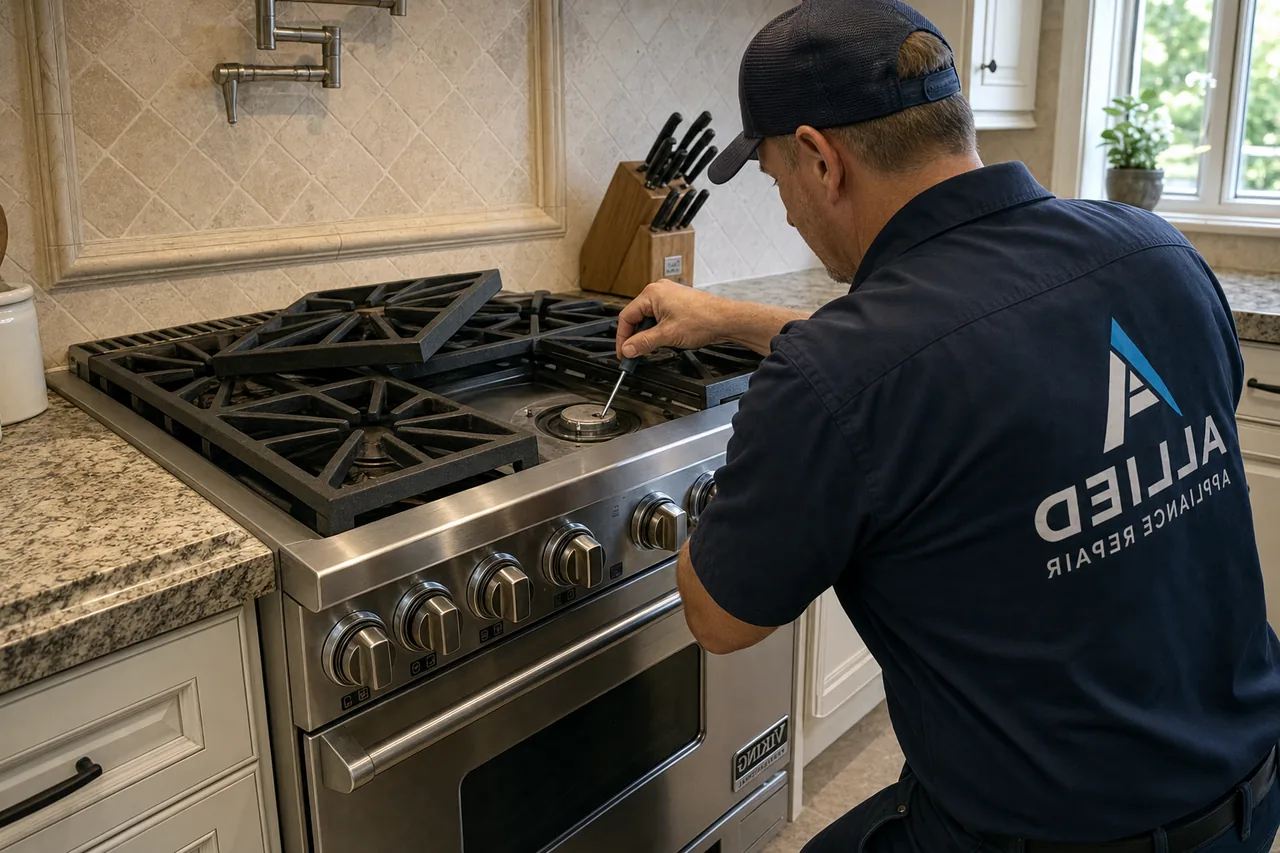
Viking maintenance is a short, repeatable routine: wipe the cooktop weekly, clean the burner ports every 3 months, and vacuum the refrigerator condenser and test the door seals every 6 months. Each session takes most homeowners 10 to 30 minutes, and a professional tune-up every 1 to 2 years covers the gas, electrical and cooling checks that are not safe DIY work.
Viking makes both the range and the built-in refrigerator in many kitchens, so the schedule below covers both. Your owner’s manual has the model-specific details.
What does a Viking maintenance schedule look like?
| Task | Appliance | How often | Time |
|---|---|---|---|
| Wipe grates, caps and spills | Range or cooktop | Weekly | 10 minutes |
| Clean burner ports, check flame | Range or cooktop | Every 3 months | 20 minutes |
| Inspect oven door gasket | Range or wall oven | Every 6 months | 5 minutes |
| Check oven calibration | Range or wall oven | Once a year | 30 minutes |
| Vacuum the condenser coil | Refrigerator or wine unit | Every 6 months | 20 minutes |
| Paper test on door gaskets | Refrigerator or wine unit | Every 6 months | 10 minutes |
| Replace the water filter | Refrigerator with ice or water | Every 6 months | 5 minutes |
| Professional tune-up | All Viking appliances | Every 1 to 2 years | 1 to 2 hours |
How do you maintain a Viking range or cooktop?
Gas burners need the most attention because spills land right on them. Once the cooktop is cool, lift off the grates and burner caps and wash them in warm soapy water; porcelain-coated cast-iron grates should not go through a self-clean cycle. Clear clogged ports with a straight pin or opened paper clip, never a toothpick, which can snap off inside. Dry every part fully and reseat each cap so it sits flat.
Then light each burner. A healthy flame is steady and blue. Yellow, lazy flames, a burner that lights on only part of its ring, or an igniter that keeps clicking usually means moisture or debris in the ports. Give a wet burner a few hours to dry. If the clicking continues once it is dry, the igniter or spark module may need attention; our range repair page covers that.
Wipe stainless steel with the grain using a soft cloth and mild cleaner, and skip steel wool and chlorine bleach, which scratch and pit the finish.
How do you keep a Viking oven baking evenly?
Inspect the door gasket twice a year. It should be soft and continuous, with no flattened spots, tears or gaps, and it should never be scrubbed or sprayed with oven cleaner. A worn gasket lets heat escape, which shows up as slow preheats and uneven browning.
Once a year, set the oven to 350°F, wait 20 minutes after the preheat signal and read an oven thermometer. A few degrees off is normal; 25°F or more is worth a closer look. Use self-clean sparingly, because its very high heat is hard on door locks, thermal fuses and control boards.
How do you maintain a Viking built-in refrigerator or wine unit?
Cleaning the condenser matters most. On most Viking built-in refrigerators it sits behind the top grille; on undercounter units, including most wine coolers, it is usually behind the front grille at the bottom. Turn the power off at the breaker, remove the grille and vacuum the coil with a soft brush attachment. A dusty condenser makes the compressor run longer and hotter, which is how small neglect becomes a large repair.
Next, close the door on a sheet of paper at several points and pull it out. You should feel firm drag everywhere; where the paper slides out freely, cold air is leaking. Clean gaskets with mild soap and water.
Keep a thermometer in a glass of water on a middle shelf and aim for about 37°F in the fresh-food section, 0°F in the freezer and about 55°F for long-term wine storage. After a water filter change, run and discard a few glasses to clear air from the line. If temperatures drift despite a clean condenser and good seals, a fan, defrost or control fault is likely; see refrigerator repair.
Does a Westport kitchen need anything extra?
Westport sits on Long Island Sound, and homes in Saugatuck Shores, near Compo Beach and along the Greens Farms shoreline live with salty, humid air. Salt speeds up corrosion on stainless trim, burner parts and condenser fins, so shoreline kitchens benefit from wiping stainless more often and checking the condenser every 3 to 4 months instead of every 6.
What should you leave to a technician?
Leave gas lines and valves, wiring behind the control panel, sealed-system refrigerant work, and igniter or bake element replacement to a professional. If you smell gas, turn the appliance off, leave the house and call the gas utility from outside.
A professional tune-up adds what a homeowner can’t easily check: a leak test at the gas connections, igniter and element performance, oven temperature and hinges, refrigerator fan motors, the defrost system and drain, and how quickly the cabinet pulls down to temperature.
Typical ranges are $95–$149 for a diagnostic visit, $250–$900 for range or oven repair and $300–$750 for common refrigerator repairs. The firm quote is given on site after diagnosis; our repair pricing page lists the rest. We are an independent service, not manufacturer-authorized, working on Viking cooking and refrigeration in Westport, Weston, Wilton, Southport and nearby towns. Call (475) 472-9274 to book.
Frequently asked questions
How often should a Viking appliance get a professional tune-up?
Every 1 to 2 years is a sensible interval for most Viking ranges and refrigerators. Heavy daily cooking or a shoreline home favors the shorter end.
Can I use oven cleaner on a Viking oven?
Avoid spray oven cleaners on self-cleaning oven interiors, and never use them on the door gasket. Warm soapy water on spills is safer for the finish and the seal.
Why does my Viking burner keep clicking after cleaning?
Water in the burner ports or around the igniter is the usual cause, and the clicking normally stops once the parts dry for a few hours. If it continues when everything is dry, have the igniter and spark module checked.